
Foreword
Nine out of ten CISOs consider digital sovereignty important. Recent geopolitical developments, for example, when an ICC prosecutor reportedly lost access to his Microsoft account after the U.S. sanctioned him, or when a U.S. export control directive forced Anthropic to suspend its newest AI models worldwide within hours, have increased concerns about disruption and foreign government access.
Yet less than half of the CISOs we surveyed actively treat digital sovereignty as a high priority. Why?
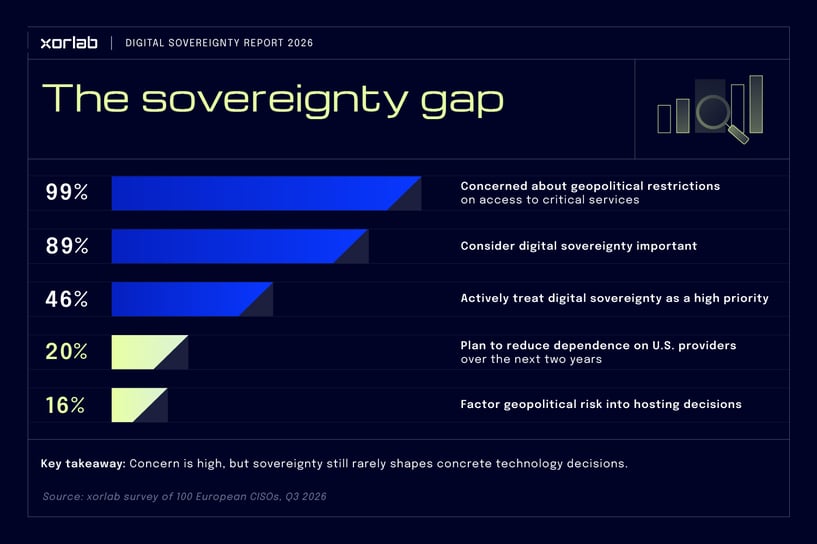
Almost all CISOs (99%) are concerned that geopolitical conflicts, sanctions, or export controls could restrict access to their critical services but they consider such a large-scale withdrawal unlikely. And if a market wide event did happen, it would be a systemic crisis making individual CISOs far less likely to carry the blame.
CISOs have a lot on their plates, and I understand why an AI-discovered zero-day exploit that could disrupt their organisation - and perhaps cost them their job - can feel more important than a U.S. hyperscaler pulling out of Europe.
The conclusion from this report is uncomfortable but clear: European organisations recognise the risks of insufficient sovereignty. But urgent day-to-day priorities and existing regulations take precedence, leaving sovereignty as an abstract concept with little clarity on what organisations should do or can realistically achieve. Even the term itself lacks a widely agreed definition.
It’s easy to assume that becoming more sovereign means abandoning all global providers altogether. In practice, that is neither realistic nor necessary. Digital sovereignty starts with smaller, manageable steps: deciding which dependencies on global technology providers are acceptable, controlling who can access your data, identifying credible alternatives where the risks are too high, and ensuring the organisation can act if circumstances change. But these preparations need to be made before access is disrupted or sensitive data is exposed, not once it’s too late. This report shows that some organisations are already moving in this direction, with 20% of CISOs considering reducing their dependence on U.S. providers over the next two years.
In this report you’ll learn whether European CISOs know where all their most sensitive data is being processed, how often their organisations bypass their own sovereignty requirements, how many would like to avoid U.S.-based service providers, and how quickly they expect disruption if U.S.-based technology providers suddenly stopped providing their products and services in Europe.
As you read, ask yourself: which dependencies has your organisation consciously accepted, and which remain unexamined?
Enjoy the read,
 Candid Wüest
Principal Security Advocate
xorlab
1. Executive Summary
 |
Only 34% of the CISOs can state with confidence, for their five most critical service providers, where all their data is processed. [Fig.1] |
 |
Operational needs often override digital sovereignty policies: 69% of organisations with formal requirements made exceptions to them at least once last year. [Fig.2] |
 |
89% of CISOs consider digital sovereignty important. Of those, 46% are working on it as a high priority, while the other 43% lack the resources or authority to address it. [Fig.3] |
 |
99% are worried that they may lose access to critical services due to sanctions or geopolitical events, but only 16% take this into account when selecting new service locations for their business critical services. [Fig.5, Table 1] |
 |
32% of organisations expect significant business disruption within one week if U.S. providers withdraw from Europe, and 58% within four weeks. [Fig.6] |
 |
39% of CISOs prefer to avoid U.S.-based service providers where possible, but none formally excludes them. By comparison, 83% of organisations exclude or prefer to avoid vendors from China, 94% from Russia and 52% from India. [Fig.8] |
 |
84% of the CISOs estimate the probability below 50% that a significant external restriction of a critical service due to geopolitical events will occur within the next five years. [Fig.7] |
 |
41% of the CISOs are defining the requirements for data residency and access controls. However, more than half of them (54%) believe the overall accountability should sit with the CEO or board. [Fig.4] |
Explore part one of the Digital Sovereignty Report 2026 below, or download the PDF to read at your convenience.

2. Main Trends
2.1 Two-thirds of CISOs cannot say with confidence where all their data is processed
Only 34% of CISOs can state with confidence for each of their five most critical service providers, where their organisation’s data is stored and processed, and who can access it. Half (52%) can do so for only some providers. This is a major blind spot and may reflect a dangerous assumption of trust on the part of CISOs. Include shadow IT and AI in the analysis, and the picture is even worse. This matters given that 93% of CISOs are concerned about foreign legal access to their organisation’s data. How can you assess that exposure if you cannot confidently describe where the data is processed and who can access it?
These gaps may reflect how difficult it can be to obtain a clear answer. Modern services are layered and complex: a SaaS product may run on a hyperscale platform, use cloud-hosted AI to process telemetry, and route logs through separate tools, with each layer documented separately, if at all. Organisations have not yet demanded this level of transparency from all service providers, or made it a mandatory requirement. While regulations like GDPR already impose transparency and requirements in many circumstances, they do not generally require all data to remain in Europe. A provider’s hosting location alone does not answer all these questions.
Knowing what data you hold, where it is processed, and how it is handled is one of the key foundations of digital sovereignty.

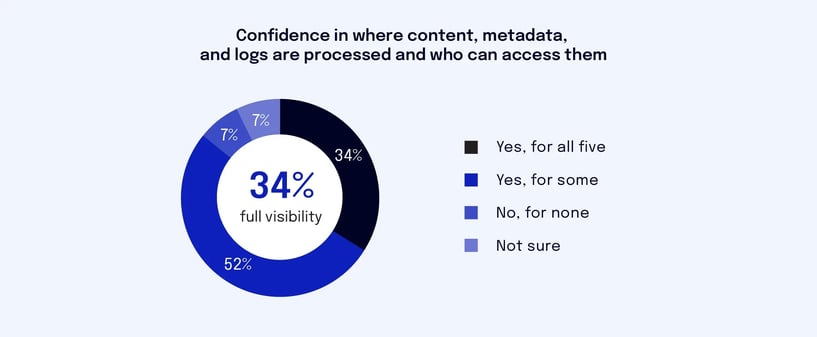
Figure 1. For your five most critical service providers, can you state with confidence where message content, metadata and logs are processed and who can access them?
2.2 Organisations bypassing their own digital sovereignty requirements is common
When asked, 22% of CISOs said their organisation currently has no formal digital sovereignty requirements. Among those whose organisations do have requirements, exceptions, such as using a provider with a hosting location that doesn’t meet those requirements, are common and occurred for 69% of them. 19% said their organisation had bypassed its requirements even more than five times in the past 12 months to get important work done. Exceptions are not automatically a sign that policies have failed. They may reflect deliberate, approved trade-offs. Operational business needs often override policies. The important question is whether they are documented, supported by compensating controls and reviewed, or become permanent workarounds.
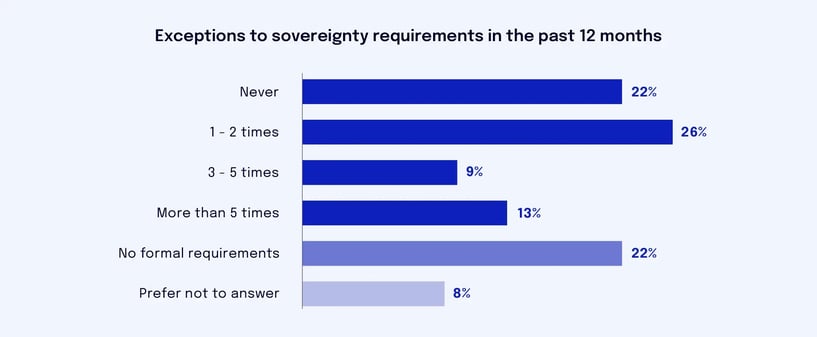
Figure 2. During the past 12 months, how often has your organisation made an exception
to its digital sovereignty requirements to meet an urgent business need?
22%
of organisations have no formal digital sovereignty requirements, and of those that have such requirements, 69% bypassed their requirements at least once in the past year.
When asked for their personal view on digital sovereignty, 89% of the CISOs said the topic is important, but only 46% consider it a high priority and are actively working on it. Another 43% recognise its importance but report competing priorities (28%) or limited influence over the relevant decisions (15%). These CISOs would like to address digital sovereignty but are blocked from doing so. Only 7% see the topic as overhyped, and just 3% do not consider digital sovereignty relevant to their organisation.
Recognising the importance of sovereignty does not automatically give CISOs the time, influence or resources to address it. We have seen a similar gap between awareness and concrete actions with NIS2, the Cyber Resilience Act (CRA), and post-quantum cryptography. Over time, however, each has become a higher priority for CISOs. The priority is to turn broad concern into requirements that can be applied consistently, with an explicit process for accepting and reviewing exceptions.
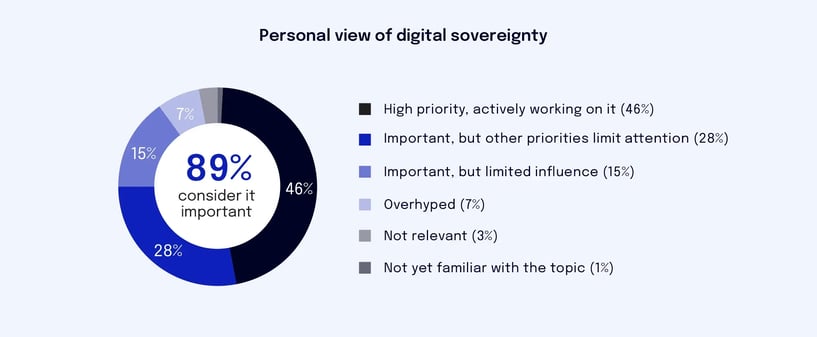
Figure 3. Which statement best reflects your personal view of digital sovereignty?
2.3 Most CISOs believe the CEO should be accountable for digital sovereignty
The majority of CISOs are already defining the requirements for data residency, processing and access controls (41%). However, more than half of them (54%) believe the overall accountability should sit with the CEO or board.
When asked about who puts the most pressure to address digital sovereignty in their organisations, CISOs named themselves (30%), well ahead of CEO and board (13%). This suggests that sovereignty is still often treated as a security issue rather than an executive responsibility.
With 25% of CISOs citing the lack of a clear business case as a barrier, security leaders need to translate sovereignty requirements into tangible business consequences, including disruption, loss of data control, contractual exposure and switching costs. Without that link, it is also harder to secure the budget and executive backing needed to reduce those dependencies.
Digital sovereignty requires both strategic ownership and operational delivery. Organisations should make clear who accepts dependency risks, who sets requirements, and who has the authority and resources to implement them.
73%
of CISOs who report limited influence over digital sovereignty decisions say responsibility should lie with the CEO.
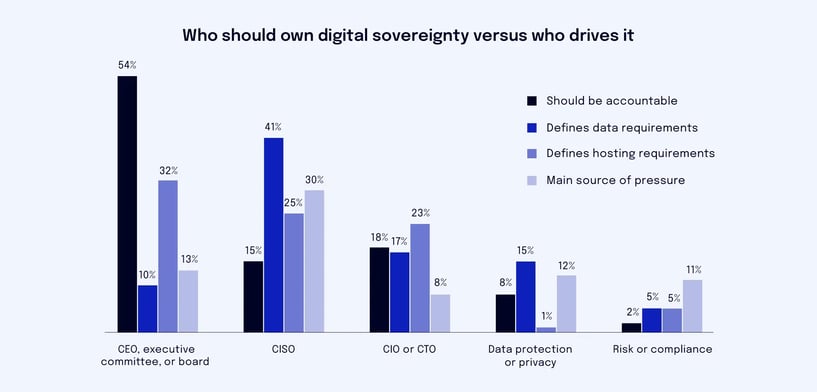
Figure 4. Who has primary responsibility for defining where business-critical services may be hosted and operated? Who has primary responsibility for defining data residency, processing, and access requirements? Who in your opinion should have overall accountability for digital sovereignty within your organisation? Which stakeholder is currently putting the most pressure on your organisation to address digital sovereignty? Top five stakeholders shown. The percentages for legal teams, heads of business units, procurement and customers were all below 5% for all categories and therefore not shown in the graph.
2.4 Geopolitics raises concern, but compliance carries more weight
Almost all CISOs (99%) are concerned that geopolitical conflicts, sanctions, or export controls could restrict access to their critical services. More than one in four are very concerned about restricted access (28%), as well as very concerned that a foreign authority could access their data or logs (31%). This should not come as a surprise. The U.S. CLOUD Act is often cited as an example of this concern. It can require a provider subject to U.S. jurisdiction to disclose data within its control, regardless of where that data is stored. Recent geopolitical tensions have added to these concerns.
Despite widespread concern about geopolitical disruption and foreign access, these risks currently have little influence on where organisations actually run critical services. Hosting decisions are driven mainly by data protection and privacy requirements (52%) and regulatory requirements (45%), indicating the biggest driver is due to regulations such as GDPR. By comparison, 16% cite geopolitical risk, 21% exposure to foreign laws, and just 8% reducing dependence on specific vendors or countries. Only 25% identify foreign-government access as one of their strongest reasons to act on digital sovereignty. Concern is widespread, but it carries less weight when organisations set priorities and choose where to host critical services.
Resilience also plays an important role: 37% cite security and operational resilience, and 29% cite business continuity and service availability. These priorities overlap with digital sovereignty. Organisations may therefore address some dependency risks through existing compliance and continuity work, even when they do not explicitly label them as geopolitical risks. The loss of access to a major provider is on every CISO’s mind, especially after hyperscaler outages from vendors such as AWS, Azure & GCP affected services in Europe last year.
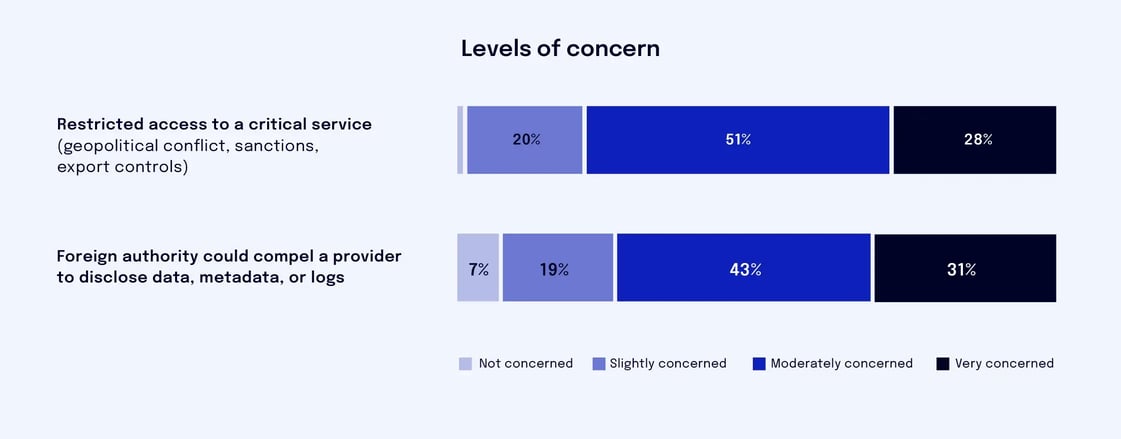
Figure 5. How concerned are you that geopolitical conflict, sanctions, or export controls could restrict your organisation’s access to a critical service? How concerned are you that a foreign government or authority could legally compel a critical provider to disclose your organisation’s data, metadata, logs, or other sensitive information?
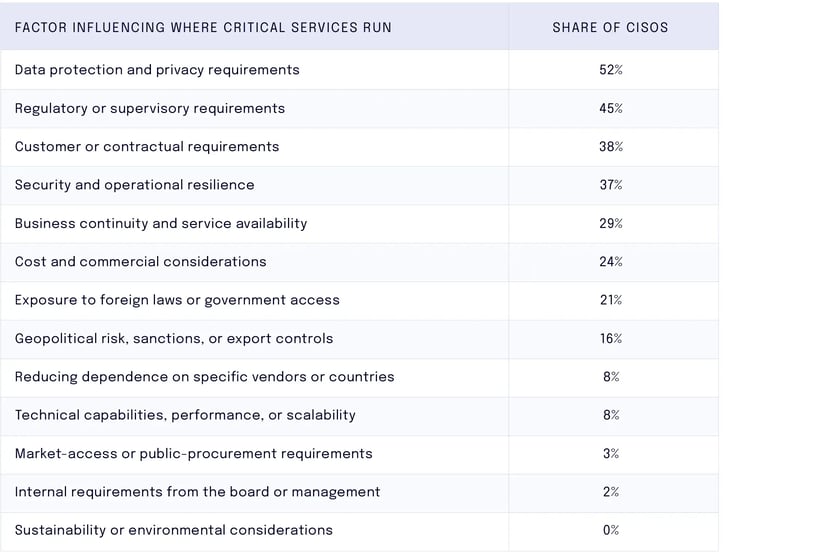
Table 1. What are the main factors influencing where your organisation runs business-critical services?
The findings suggest that established privacy, regulatory and contractual requirements carry more weight in hosting decisions than geopolitical concerns alone. The practical question is whether broader assessments adequately cover foreign legal access and service restrictions, or leave those scenarios unexamined.
Planned actions suggest these issues may become more explicit. Within the next two years, 40% of CISOs expect more detailed sovereignty or jurisdictional risk assessments, and 47% expect stricter data storage and processing location requirements. The next step is to translate concern into clear criteria for procurement, architecture and continuity planning.
2.5 One third of CISOs expect significant disruption within a week of U.S.-provider withdrawal
CISOs were asked to imagine that U.S.-based technology providers suddenly stopped providing their products and services in Europe because of geopolitical developments, and to estimate how long their organisation could continue operating without significant disruption.
32%
of organisations expect significant business disruption within one week if U.S. providers withdraw from Europe, and 58% within four weeks.
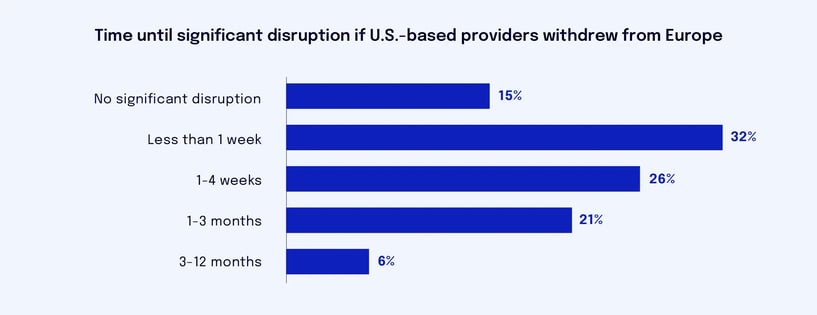
Figure 6. Imagine that U.S.-based technology providers stop providing their products and services in Europe due to geopolitical or political developments. How long could your organisation continue operating without significant disruption?
The short disruption windows highlight the importance of preparing before access is lost. Replacing critical services at short notice may be difficult, particularly where identity, integrations, data and skills depend on the same provider. Organisations should compare their expected time to disruption with the time needed to activate continuity arrangements or migrate. Keep in mind that these answers are self-reported, and some organisations may overestimate their resilience, especially given that only 34% know where their top five providers process their data.
The resilience implications of this dependency are increasingly becoming part of business continuity management (BCM) discussions, as the CEO asks for a plan B and an exit strategy. 84% of CISOs said that when selecting a new provider for a business-critical service, it is important to be able to exit or migrate easily. The EU Data Act addresses barriers to switching data processing services, while DORA includes documented and tested exit-plan requirements for relevant financial-sector organisations. Being able to migrate your data is important, but the privacy aspect of who can access your data needs to be addressed as well.
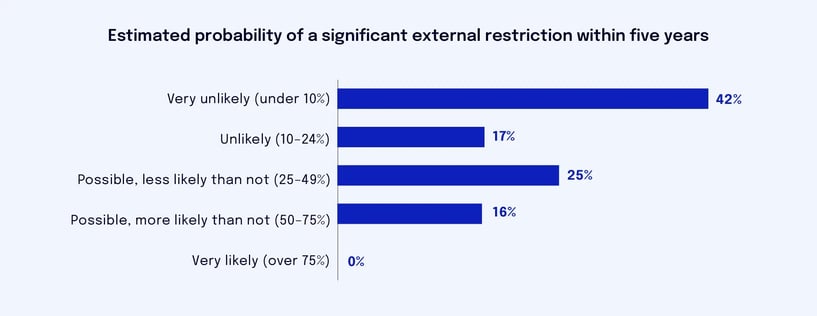
Figure 7. What do you estimate is the probability that, within the next five years, an external event will significantly restrict your organisation’s access to a critical digital service or technology over which your organisation has limited control?
As the saying goes, fear of zombies may be high, but that does not make an attack likely. CISOs similarly worry about major disruption caused by geopolitical events, yet see it as unlikely: A combined 84% consider a significant external restriction of a critical service within the next five years unlikely. Only 16% put the likelihood above 49%, and none above 75%. It is a classic low-probability, high-impact risk - one that can easily be overlooked in day-to-day prioritisation. Yet such events are no longer hypothetical. In June 2026, a U.S. export control directive forced Anthropic to suspend its newest AI models, Fable 5 and Mythos 5, for customers worldwide, with access cut within hours of the order. It was a targeted restriction rather than a hyperscaler withdrawal, but it showed how quickly a critical service can disappear for reasons entirely outside the customer’s control.
Organisations should prepare in proportion to the potential impact, with business continuity and exit options that can be activated when needed.

2.6 Four in ten European CISOs prefer to avoid U.S. service providers, but none formally excludes them
CISOs were asked what restrictions they apply to vendors of business-critical services and software based on the vendor’s country of origin. Russia has the highest rate of formal exclusion (68%) and the strongest combined exclusion-or-avoidance signal (94%). For China exclusion-or-avoidance is at 83% and for India at 52%.
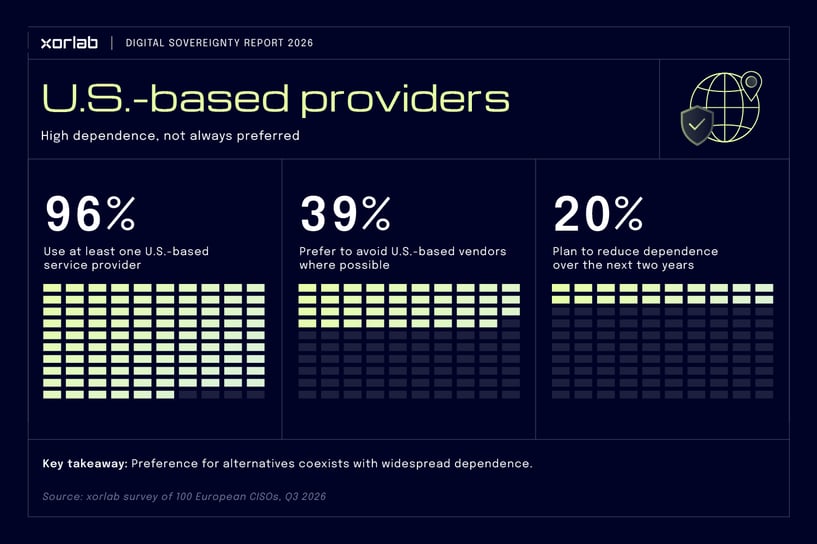
Although the U.S. CLOUD Act is often raised as the first example of foreign legal access, U.S. dominance in the hyperscaler market makes those providers difficult to completely avoid, even for organisations that would prefer to do so. 96% of CISOs use at least one U.S.-based service provider. This might be the reason why no organisation formally excludes U.S. based vendors, but 39% prefer to avoid them. There are signs of change: 20% of CISOs plan to reduce their dependence on U.S. providers over the next two years. However, only 8% currently cite reducing dependence on specific vendors or countries as a factor in hosting decisions. Reducing dependency is therefore on the agenda for some organisations, but turning that ambition into routine procurement decisions remains a challenge.
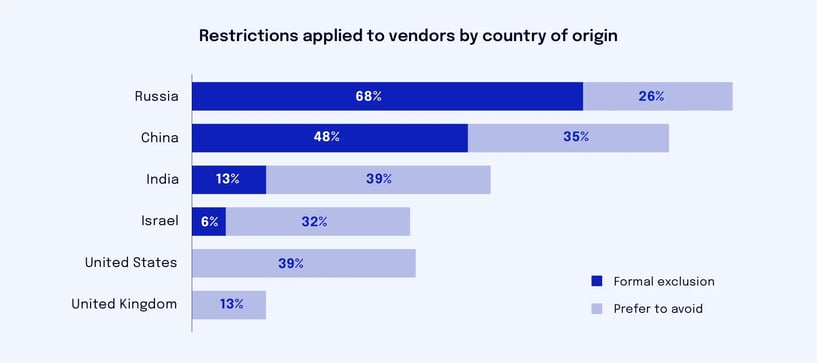
Figure 8. For business-critical services and software, what level of restriction does your organisation apply to vendors based on their country of origin?
17% of organisations have a default policy that services must be hosted on infrastructure operated directly by their organisation. This indicates interest in on-premises operations for business-critical services as part of digital sovereignty, in order to control data access more thoroughly.
For most organisations, outright exclusion of U.S. providers is not a realistic option. The more practical question is which dependencies the organisation is willing to accept, and whether it has credible alternatives for those it is not. Formal exclusion may not be viable when comparable alternatives at a reasonable price are not yet widely available. At the same time, many European initiatives are working to develop exactly such alternatives. Part two of this report examines the main barriers reported by CISOs: a lack of suitable alternatives (48%) and higher costs (43%).
U.S. based service providers are still widely accepted, but CISOs have begun looking for regional alternatives and exit strategies.

2.7 CISOs fear being switched off more than being spied on
When asked which risks are the strongest reasons to take digital sovereignty seriously, a combined 83% named loss of access to critical services (58%) or loss of control over sensitive data (50%). Exposure to foreign laws and government access, the risk that dominates the public debate, was mentioned by only 25%.
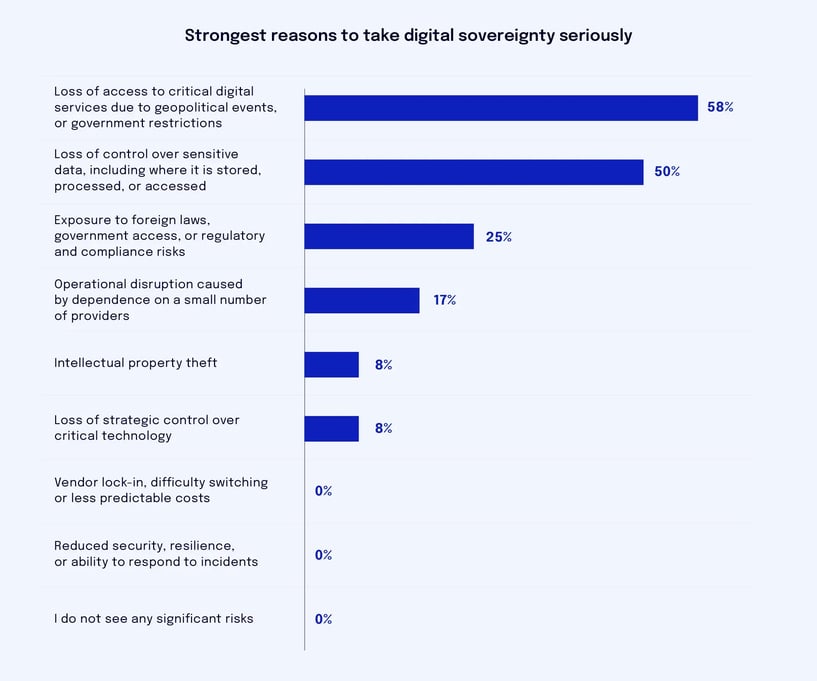
Figure 9. Which potential risks are the strongest reasons for your organisation to take digital sovereignty seriously?
This is a striking gap. 93% of CISOs are at least slightly concerned that a foreign authority could compel a provider to disclose their data, and the U.S. CLOUD Act is the most cited example in every sovereignty discussion. Yet it is rarely the reason organisations act. Together with the resilience drivers in Section 2.4, the picture is consistent: for most CISOs, digital sovereignty is first about keeping the business running. This also explains why exit readiness is valued so highly, and why the biggest anticipated regret is failing to prepare migration and exit options (42%).
Vendor lock-in was not named as a risk, but 23% cite lock-in and long-term contracts as a barrier to progress. Currently many organisations appear to be repeating the cloud lock-in pattern with AI providers, and dependencies across models, APIs, data and infrastructure will make a future switch far harder than changing a single provider.
The findings suggest that CISOs are most motivated to act when sovereignty risks threaten business continuity. Concerns about foreign government access remain widespread, but keeping critical services running is the leading priority. That makes the ability to maintain access or switch providers a central part of the sovereignty business case.
For most CISOs, digital sovereignty is first about keeping the business running.

3. What this means for organisations
The findings of this report point to two priorities regarding digital sovereignty for organisations: clear ownership and better visibility.
Here are six steps organisations should take:
|
Put responsibility at the right level. 54% say accountability belongs with the CEO or board. Make an executive accountable for accepting strategic dependency risks, and give the CISO the authority and resources to coordinate implementation. Define who sets requirements, who makes procurement and hosting decisions, and how disagreements are resolved. |
|
Map where your data is and how it is processed. Identify where data is stored and processed, who can access it, and which jurisdictions apply. Visibility into data residency and data sovereignty is essential to a meaningful digital sovereignty strategy. |
|
Set requirements you can enforce. Match requirements to workload sensitivity and business impact. Where exceptions are necessary, document who accepts the risk, the compensating controls and a review or expiry date. Repeated exceptions should trigger a review of the requirement or the available alternatives. |
|
Ask providers for specific evidence. Verify where content, metadata, and logs are processed, which subcontractors are involved, and where support and privileged access take place. Check that provider information matches the contract and relevant legal obligations. |
|
Include geopolitical risk in decisions. Add jurisdiction, foreign legal access, and service-restriction scenarios to procurement and architecture reviews. Assess both continued service availability and control over data. Record which risks are accepted and which require additional safeguards. |
|
Test continuity and exit options. List the services the organisation cannot operate without, their dependencies, and the steps, costs, and time needed to keep operating or switch providers. Check that data and workloads are portable if needed, and test the plan. Data export alone is not a complete exit plan. |
4. About the survey
This report is based on responses which were collected in Q3 2026 through a survey agency. In total, 100 CISOs from the European region shared their assessment. The results should be read as indicative of the views of a group of experienced European CISOs. All results are self-reported and describe perceptions, concerns, and reported practices rather than verified facts about providers, laws, or markets.
For the purposes of this report, digital sovereignty means an organisation’s ability to maintain control over its data, technology, infrastructure, and critical service dependencies while limiting its exposure to external legal, operational, supply-chain, and geopolitical risks.
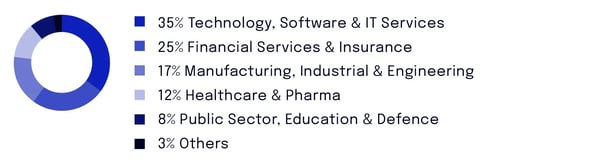
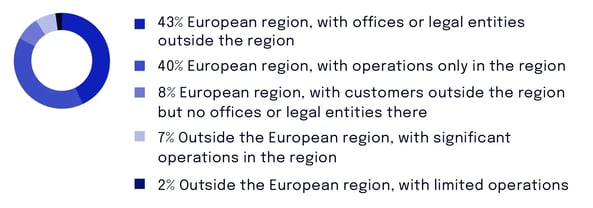
Data source at a glance
|
Organisation size |
 |
|
Industries |
 |
|
Headquarters |
 |
|
European region |
|


5. About xorlab
xorlab is a European email security platform that blocks the advanced phishing attacks Microsoft 365 and on-premises filters miss. We help organisations move from reactive defence to proactive threat prevention with a behavioural AI email security solution built for complex, high-security, and highly regulated environments.
Beyond enhanced threat prevention, it provides all the capabilities modern SOC teams require: from unparalleled visibility into email flows to powerful automation use cases, such as abuse mailbox handling, where employees can report suspicious emails and responses are intelligently automated using AI.
Trusted by organisations ranging from 500 to 37,000+ employees, xorlab counts Julius Bär, Vontobel, Swisscom, and CERN among its customers.
6 out of the 10 largest banks in Switzerland use xorlab.

Organisations can deploy xorlab on premises with fully local processing and storage, in hybrid configurations, or in the cloud, where European data centres and EU-based staff handle all operations.
The platform is built for critical infrastructure and other highly regulated environments and compliant with DORA, NIS2, and GDPR.